Samnang Eam sits at an old, white kitchen table wearing a black, button-up dress. Her thick, black curls tumble towards the seat of her chair and camouflage into the fabric of her outfit. Bangs sweep over her left eye and partly conceal it from view. But they can’t hide the tears that flow down her face and occasionally drop to the table’s shiny surface. Eam looks away when she speaks as if entranced in a memory that carries her somewhere outside the tiny, windowless meeting room. The confident woman who greeted me only minutes earlier on her front porch in Ottawa, waving a hand of sparkling pink fingernails, is suddenly struggling to get her words out. Her mind seems to wander through Cambodia’s jungle and through family conversations as she reveals the details of how her four siblings died. The year was 1979, the Vietnamese had liberated Cambodia from the Khmer Rouge and many families jumped at the chance to flee the country. Eam was born in the jungle somewhere between Cambodia and Thailand. Her memories of the escape, like those of second generation Cambodian-Canadians, belong to her parents. They were given to her five years ago when she was 29.

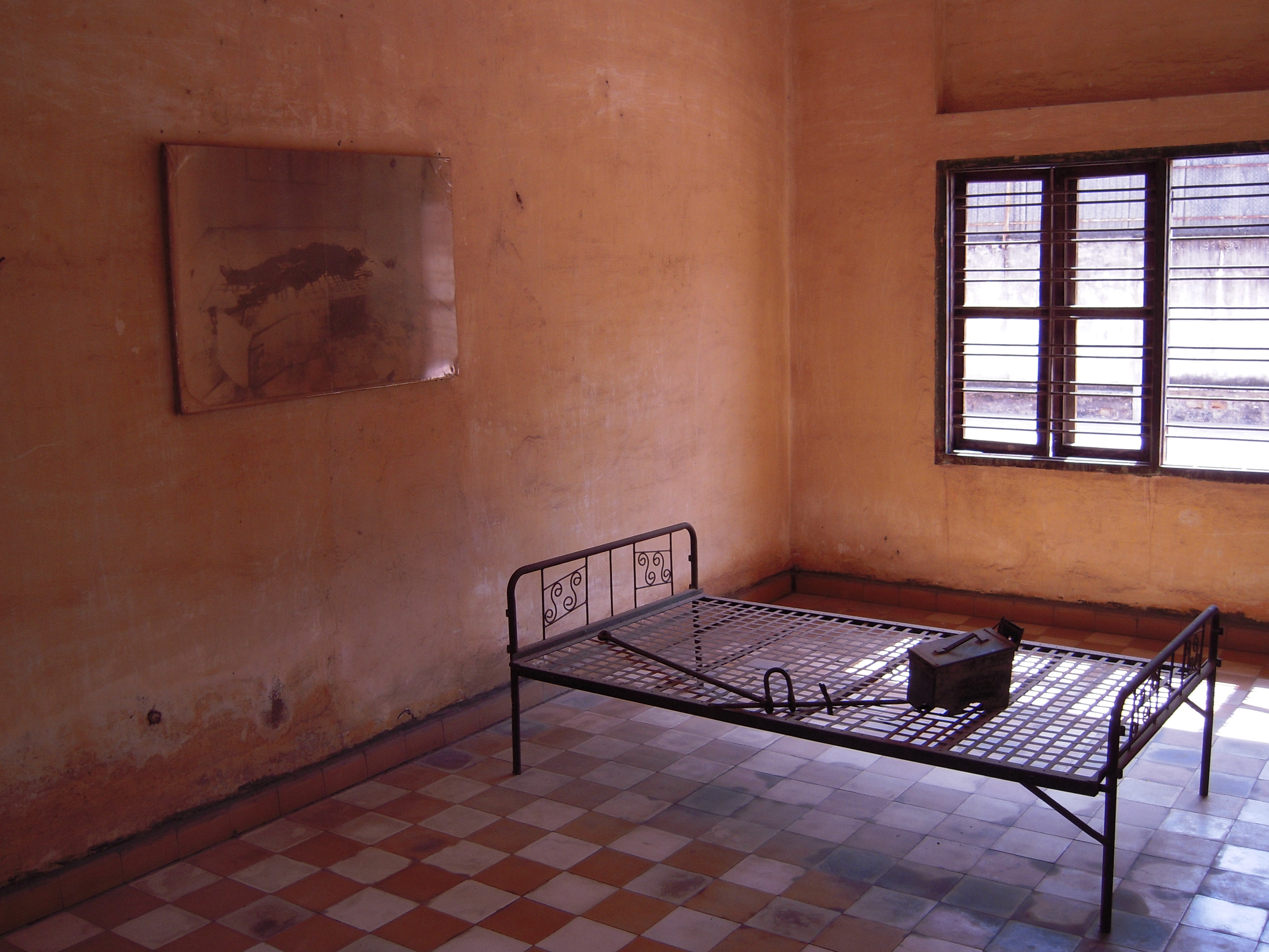
Classrooms converted into interrogation rooms at S21
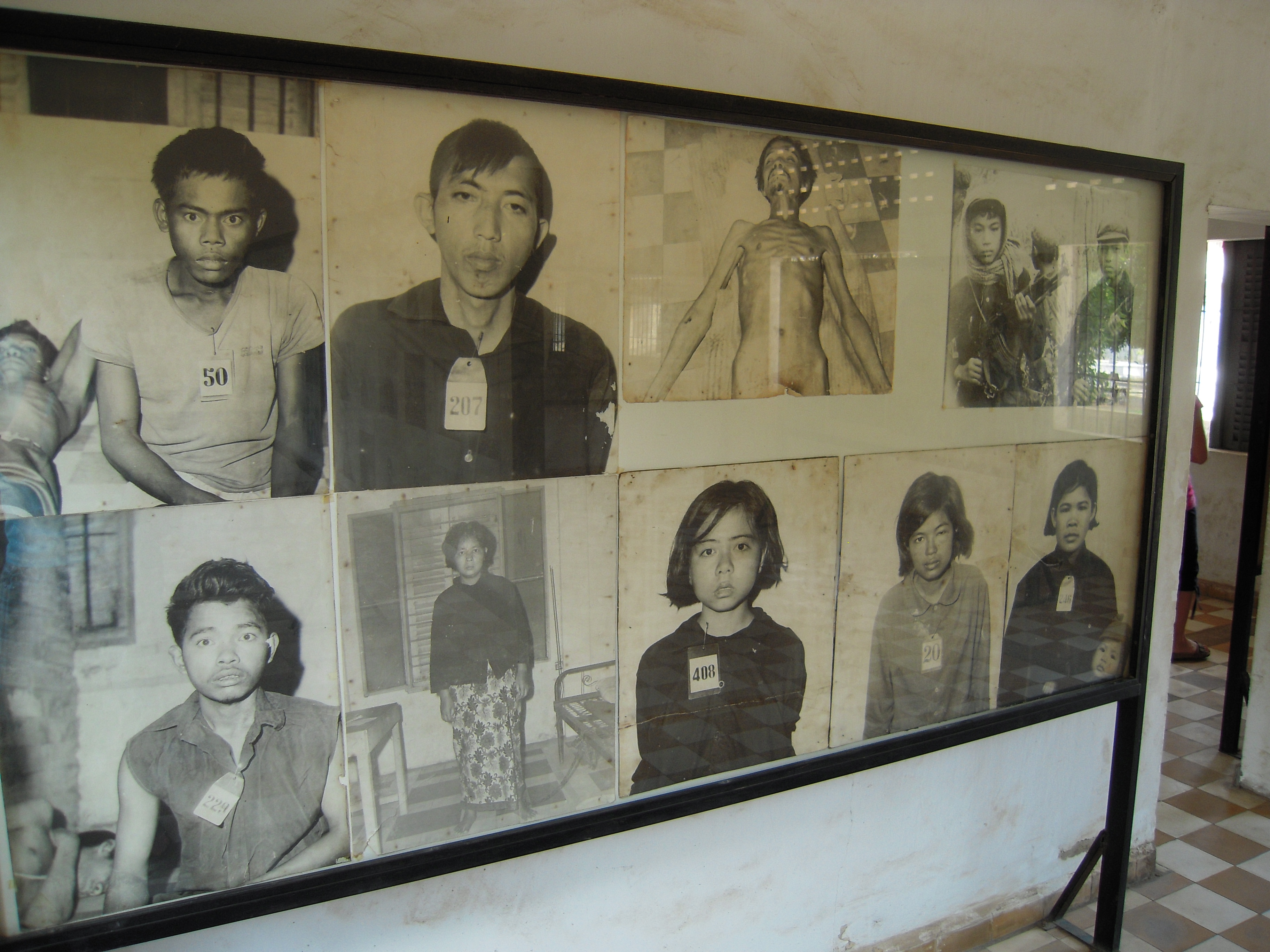
A wave of hot, musty air overwhelms my lungs as I enter each building of the Tuol Sleng Genocide Museum in the capital city of Phnom Penh. I sweat and picture what life must have been like for the people who died here – in crumbling, converted classrooms with stained white and red chequered floors. Display boards leave little to the imagination. Wide-eyed portraits stare down barbwire-covered hallways wearing expressions of horror. Torture devices, bones, paintings and documents listing rules, line the walls of the regime’s most notorious, and at the time secret, interrogation camp – then called Security Prison 21. Yet as a tourist far-removed from such violence, I struggle to believe it actually happened. I’m not alone. Even survivors of the Khmer Rouge regime have a hard time convincing their children that Cambodians tortured, executed and starved other Cambodians for four years and ultimately killed 1.7 million people. Some families avoid discussing the subject entirely.
Over 13,000 Cambodians came to Canada as refugees in the decade after the Khmer Rouge fell. Eam spent the first five years of her life in a Thai refugee camp before moving to Ottawa to live, as she would say, like a normal Canadian kid. But Eam’s birth and family history are far from relatable to the average Canadian-raised child. Cambodia’s story is understood through pictures taken from the perspective of the Khmer Rouge. Mangled bodies, living skeletons, torture devices, movies like the Killing Fields and haunting images of prisons are well known. News articles and broadcasts repeat the statistic that 1.7 million people starved, were executed or died from exhaustion induced by forced labour. But not all Cambodians perished during the four years between 1975 and 1979 during which the Khmer Rouge turned the country into a nation of slaves. This is the story of one family’s escape to Canada, the history that followed them and a young woman’s struggle to understand her parents’ memories after growing up Canadian.
Generational divide
Eam used to wonder if she was adopted. She laughs and calls herself the “rebel” child of the family. “I’m so different from them,” she said. When I first met Eam on her porch, it was January and the snow banks towered above her head. She later tells me her height and explains how being small never stops her from doing anything. “I’m 4’10 and three quarters at most,” said Eam. “I’m very loud. So when I want something done, I’m gonna get it done.” She is president of the Cambodian Association of the Ottawa Valley, a trained police officer, a part-time spa manager, a mother and a volunteer with countless organizations. At 33, she bursts with energy and confidence. Eam now sees her parents in herself. As a child, this wasn’t so easy. Growing up as a refugee in Canada, Eam felt she had no proof of where she came from. There were no pictures of her pregnant mother or smiling images of her parents holding a new baby. There were no baby pictures at all. “People are so lucky. They don’t realize that having a baby photo of you – it’s something like a gift,” said Eam. Her parents tried to make up for the lack of images with words. Eam now confesses that, as a teenager, she didn’t want to hear their stories.
I phoned Eam after our initial meeting to learn more about what she was like as a teenager. She explained that her younger self was hard to get along with. “I smoked cigarettes at 12,” she said. Eam would lie to her parents and sneak out of the house to go to parties. Her mom spent hours driving around looking for her and would often call the police and local community centre workers to help with the search. Then, one night, Eam came home to find her mother crying in the hallway. She paused on the phone and her tone revealed a strong sense of regret for her past actions. “I hugged her and I swore I would never do it again…and I never did,” she said. Eam’s knowledge of what her parents went through helps her put a lot of their behaviour in perspective. Back then, she didn’t understand that their need to protect her stemmed from memories of losing four of their children.
Bonds of trauma
To escape the burbling of a fish tank, Eam leads me down a winding staircase to the basement of the family home. She jokes about killing her mother’s fish in the past and is too worried to unplug the tank in case something should happen to them. Eam’s parents are now retired and spend six months of the year in Cambodia with the family they left behind when they came to Canada as refugees. Eam lives with her mother and father because she isn’t married and the family prefers to support each other. She is still adjusting to them being away for so many months. We walk through a meticulously organized storage area into a meeting room with a white kitchen table and chairs. Green-grey walls and laminate floors make the room feel like a secret space hidden in the back of an otherwise unfinished basement. Tufts of pink insulation tucked under sheets of clear plastic lay between exposed floor beams. Only the ceiling remains unfinished. A whiteboard hangs on the wall with the phrase “everybody talks” written in black felt marker on pastel squares of paper. It is Eam’s motto and one she enforces during Cambodian association meetings. At first we sat in a silence unfamiliar to a room often filled with the voices of Ottawa’s Cambodian community leaders. Eam placed a glass of water and a black notebook on the table. “There is no set path. Just follow your heart,” was printed in shades of fluorescent pink on the cover.
I ask Eam what life was like for her parents’ under the Khmer Rouge. Her mom worked at a nursing station and her father was a teacher, but they pretended to be uneducated when the Khmer Rouge came to power. Educated people were dubbed threats to a regime that sought to build a nation of peasants. Eam said Khmer Rouge soldiers forced her family out of their home on April 17, 1979. But the Khmer Rouge took over the country on April 17, 1975, four years earlier. The Vietnamese liberated or, by some accounts, invaded Phnom Penh on January 7, 1979. Eam’s dates don’t match the history. We stumble through several questions before moving on without definite answers. When I phoned Eam back to clarify, she sounded unsure and admitted not knowing all the details. “I wish my dad was here,” she said with a sigh. But this story isn’t about facts. It’s about the confusion and emotions brought on by traumatic memories and how families deal with those memories. Eam could only tell me what her parents told her. She might not know where her family lived in Cambodia or when they were forced to leave, but she does know that her parents experienced loss as they tried to get their children to Thailand. I let Eam share her family’s version of their escape.
Knowing hurts
Landmines made every step a life or death decision. “They started off with a bunch of different families and one by one lost many,” she said in a disconnected voice as if talking about people she doesn’t personally know. Cambodia is one of the most heavily mined countries in the world along with Egypt, Iran, Angola, Afghanistan and Iraq. Eam tells the story in snapshots. She does not know enough about how the pieces fit together to develop a continuous narrative. Her parents, Sam An Eam and Kim Ting, ran with their three sons and two daughters, all under the age of 13, through Cambodia’s dense jungle. Eam opened her black notebook to reveal a stick figure drawing of a man carrying two circles sketched in black ballpoint pen. She explained that the circles represent two small children. Above the drawing the following list appeared:
Yong 12
Bro 10
Bro 8
Sister 6
Sister 4
Eam never refers to her deceased siblings by their names at any point in our conversation. That could be because she only found out about them less than five years ago. “I really actually believed, in my mind, maybe I didn’t listen properly when I was younger, I thought, two kids.” She has never seen a picture of her brothers and sisters. But they are more than nameless, faceless children. Eam explains how her parents struggled up and down mountains and across rivers. Soldiers captured them several times and forced them back into Cambodia. Only when we started talking about the children, though, did Eam choke on her words and look away. She paused and apologized for crying. She told the rest of the story in tears, partly composing herself between descriptions of each child’s death, only to unravel again when she started talking about the next child.
The two little girls died first. Eam’s oldest brother, Yong, the only child to survive, helped his father bury their bodies. He was 12-years-old. Her mother couldn’t watch. The need to keep running meant leaving their daughters’ bodies in the jungle. Starvation and dehydration threatened them as often as landmines. When Eam’s father found a root that looked edible, he dug it up and offered it to his sons. The eight-year-old refused to eat claiming he knew he was dying. Tears stream down Eam’s face and she carefully wipes them away with a tissue, trying not to smear her makeup. “I guess for an eight-year-old to tell you that…to look at your face, I can’t imagine like what that would do to someone,” said Eam. “I can’t imagine…what my parents had to go through.” He died that same night. Eam struggles to control her sobbing as she tells me her second oldest brother was the last to die. The ten-year-old held his father’s hand and begged for them to leave him in the jungle. Eam’s father stayed up all night cradling his son. “[T]hey didn’t want to leave him. He held him all night and he died,” she said.
But amidst the death and suffering, Eam, a newborn, survived. Her mother gave birth to her in the rainy jungle with no doctors and no running water on May 7, 1979 at seven in the morning. She claimed her parents were trying to survive by drinking each other’s urine. Eam’s mother was so severely dehydrated and malnourished that she couldn’t feed her daughter. “[M]y mother wasn’t even lactating, so I wasn’t being able to be fed,” she said. The emphasis in Eam’s voice revealed the shock she feels about her own survival. Her parents named her “Samnang,” which means “lucky” or “good fortune” in Khmer. She was one of the few children to survive.
According to Eam, it took months for her family to reach a transit camp in Thailand. It was a chaotic and crowded place. Trucks kept dropping more and more people off. Eam’s parents fixated on the vehicles thinking their children – the four they buried in the jungle – would eventually step off one. “They just th[ought] that maybe they didn’t die and maybe all their kids are […] just going to get off those trucks and be like all the other Cambodians that did survive,” said Eam. Several months on the run with almost no food and water had taken its toll on her parents. A Thai couple offered to help baby Samnang. The painful thought of losing a fifth child forced them to give her away. They prepared to leave for the more permanent refugee camp with their one surviving son. But, at the last minute, Eam’s mother went to find her daughter in the sea of people. Eam told me her parents said she never cried during the escape from Cambodia. Yet she laughed and said it was her screaming that eventually reunited the family. The Thai couple couldn’t get Eam to stop crying and wanted to give her back. But their reunion was really a matter of luck. “[I]t was minutes, literally minutes, before I would have, I guess, had a different life,” she said. Eam admits feeling upset that her parents gave her away. “I was like, ‘you gave me away? I can’t believe you gave me away!’ Not realizing they didn’t want to give me away.”
I ask what it’s like to know these details about her siblings’ deaths, but not have any of her own memories about her family’s traumatic past. Eam wishes she could share some of her parents’ pain or take some of the burden from them. Her emotions and sadness come from thinking about how much her parents suffered and still suffer over the loss of their children. “I feel so bad for them to actually have to go through that,” she said. “Mine was just a memory told by someone else.” She feels guilty for being a “bratty” teenager and for making her parents worry by sneaking out of the house. Eam waited so long to ask her parents because she was scared and didn’t want to know. She heard snippets of information growing up and admits not wanting to confirm that her family and other Cambodians saw and experienced horrible things. “I didn’t want to be saddened by it,” she said. “But that was just kinda selfish of me. Not in a bad way, I don’t think, I just think I wasn’t ready.”
When Eam finally got to hear her parents tell their story, she couldn’t stop crying. “We can only imagine what that’s like, but we don’t know…until you look into someone’s eyes and you have to watch them tell you that story about losing their kids,” she said. The conversation started one night before Eam was supposed to go out with two girlfriends. Her mother, father and oldest brother sat on and around puffy burgundy and black leather couches in the upstairs living room. When Eam’s girlfriends arrived, they cancelled their planned night out to listen to her family’s story. Eam took notes to help her remember and understand everything. She said she is proud of where she comes from and is thankful for the sacrifices her parents made to bring her to Canada. She wants other Cambodian-Canadians to feel the same way.
The past is a secret
But unlike Eam’s family, many Cambodians do not talk about the regime. And parents don’t always share their stories and experiences with their Canadian-born or raised children. Eam knows firsthand that discussing the Khmer Rouge forces people to mentally return to a time they wish they could forget. She watched her parents cry and unravel their pain in front of her. “It’s a place where they don’t wanna go,” she said. “They know it happened, but I guess remembering and talking about it again, I feel like it’s opening the doors for more hurt.” Yet she thinks it is important for people to discuss their memories and know that others will support them when they need help. Janet Prak would agree. Recently elected to the position of vice president of the association, she will take on her role in May. Prak is 29. She got involved in the community at the age of five by participating in traditional Cambodian court dancing. Like Eam, her parents were open with her about their lives under the Khmer Rouge. But, as a child, she felt confused by their behaviour and her heritage. The process of learning her family’s history made Prak realize that other Cambodian-Canadian children might benefit from hearing her story. She wants to ensure that the past is not lost among younger generations and sees the association as a way to create awareness.
As a child, Prak remembers finding her mother sitting alone in the dark all the time. She thought her mom was angry with her and never understood why. Then, one day when she was 13 or 14, Prak decided to do something. “I said, ‘mom, you know, stop sitting in the dark. You need to come out. You need to tell me what is on your mind.’ And she said, ‘Janet, look over there. Do you see your grandfather?’ I said, ‘no mom, what are you talking about?’” Prak’s mother believed she was sitting alone in a dark room with family members who had been killed by the Khmer Rouge. She admitted to her young, Canadian-born daughter that she felt responsible for the death of her father, first husband and youngest brother. She watched Khmer Rouge guerrillas execute all three of them and was playing the scene over and over again in the darkness of her Ottawa home. Prak worried about her mother and wanted to give her a way to share her pain. “She started to walk me through the whole story,” said Prak. “So this was an after school thing.” Starting in grade 10, Prak would come home, listen to her mother, cry and record their conversations in a diary. “That was sort of a way for me to bond with my mom to kind of get her to be in sort of a healthier state of mind,” she said. At the time, Prak didn’t know what she wanted to do with her mother’s story; she just knew she had to do something with it.
A new kind of leader
Eam spent a lot of time with other Cambodians when she was growing up in Ottawa. Her father sat on the association’s board for several years and had her volunteering from a young age. The family often takes in new Cambodian-Canadians and gives them a place to stay until they find jobs. Until two years ago, Eam didn’t think she would ever undertake a leadership role like her father. But when she went to cast a vote at the association’s annual meeting, her opinion changed. Eam was on her way to a picnic and was wearing a sundress and flip-flops. She had her daughter and niece with her. “Little did I know the community had put my name in the ballot…and I won,” she said. Eam remembers feeling unprepared to accept the position, but decided to embrace the role of president anyways. It was what the community wanted. Prak has known Eam for 15 to 16 years. She understands why people chose Eam to be president. “She’s an amazing person. She’s very kind-hearted. Very giving,” said Prak. Prak believes Eam’s age places her in a better position to connect with Cambodian-Canadian youth. “She doesn’t push people to participate,” said Prak. “She’s like your friend and she gives you that choice.”
In 2010, the association threw a party to celebrate the 30th anniversary of the first wave of Cambodian immigrants to Canada. Eam looks back on this event with pride because it brought so many members of the community together to celebrate their lives in Canada. The room bustled with hundreds of people. Cambodian families, sponsor families and Members of Parliament joined together to share food, entertainment and the history of two countries. Old photos hung, accompanied by sponsorship information, in a corner of the room. Women and men performed traditional Cambodian dances wearing costumes accented in gold. A constant hum of excitement from the audience, at times, threatened to overtake speakers at the podium as they read out letters from Stephen Harper and Jack Layton. Everyone danced to live music under flashing lights. Singers wore gold and red sparkling outfits as they took turns revealing the delicate, fluctuating sounds of Khmer.
But one act stood out among the dance performances and speeches. A small, young woman stood on stage in bare feet, wearing a black dress and a turquoise-green coloured scarf. She recited a poem that she had written about the Khmer Rouge regime and dedicated it to all the parents who survived. That woman was Janet Prak. She wrote the poem using her diary and years of conversations she had with her mother. It was six minutes long and recited in both English and Khmer. Parts of it were general and others specifically about her mother.
Morning, my mother would work: on her back a pair of blackened clothing, blackened with mud, blackened with communism.
At noon she would eat nothing short of a few scoops of rice and boiled weeds with just some salt.
At night, she would lay inside her hut, ear and face planted on the ground searching for sounds of horses like “Click, Clack, Click, Clack” she would listen. “Are they coming for me she thought?”
Pressed, her hands together she would pray, “let me live another day so I can keep working the rice fields,” and when the horses stopped a few huts down – a sound of ruffling, and the Khmer Rouge whispered: “Do as we say or you will see.”
Prak spoke her poem with serious intensity to the sound of a bow and string instrument called a trow. The music, combined with the audience’s chatter, left Prak battling for her words to be heard. As I watched the YouTube video, I wondered how people in the room felt. Eam described that night as an experience of contrasting emotions. “It was a bittersweet moment because you’re remembering things that happened, but you’re also embracing the new things that are happening,” she said.
When I spoke with Prak, she admitted several older members of the board contested her poem. They wanted the party to be more about happiness and celebrating than about remembering the horrors of the past. They told her, “we don’t want to make everybody feel depressed.” But Prak thought ignoring the past would do a disservice to younger generations of Cambodians. “If we were to take this very important piece of information, hide it under the carpet, I don’t think that’s fair and that’s realistic in terms of what really happened,” she said. “I really was fighting against, you know, the older generation, what they thought.” Prak decided to recite the poem despite opposition. She angrily explained her reasoning. “Whether or not they disagree and they think that this is too sad a poem to share with everyone, I’m going to do it anyway because, um, I’m tired of it,” she said. Prak is tired of the older generations’ belief that the Khmer Rouge regime has little to no impact on Cambodian children born and raised in Canada.

The faces of S21’s prisoners are on display at the prison turned museum
Prak told me that almost none of her friends’ parents share details with them as her mother does with her. She said silence damages more than those who survived the regime. Unanswered questions leave Canadian-raised children confused about who they and their parents are. Prak describes her mother’s stories as the missing pieces of her identity. Both Eam and Prak view the association as a way to help younger Cambodians connect with their heritage and with people from older generations. “I see the community as one big family,” said Eam. Both are also willing to share their personal stories with others to help Cambodian-Canadians understand the past. “Knowing your roots is very important,” said Eam. This is an attitude she will carry into her second two-year term as president.
At Tuol Sleng Genocide Museum, photographs lay still beneath panes of glass. Faces of men, women and children wear one expression: fear. Eam hasn’t visited the rooms of the prison turned museum. She hasn’t inhaled the thick, hot air. She has not been to Cambodia since her birth. Eam knows and believes the horrors of the regime because of her parents’ stories. But many pictures remain trapped in the memories of those who saw the acts of violence firsthand. Eam and Prak are part of a generation raised in a different culture – one that shares knowledge and prioritizes openness. Both women became visitors in their parents’ unique memories and stories. Encouraging other Cambodian-Canadians in Ottawa to do the same has been a slow process. Yet Eam feels that conversations are important to help people overcome the trauma that is rarely discussed. “With the community being able to talk a bit more, I think we’re only going to get better,” she said.





 Heather Caulder