I read an article in the Guardian about a Cambodian journalist a few weeks ago and wanted to share my reactions. I follow the Khmer Rouge Tribunal (KRT) and acquired an interest in Cambodian history after living in the country for a month in 2010.
Journalists take risks every day, but only a select few gamble their lives in the pursuit of truth. Cambodia’s Thet Sambath has wagered everything – home, family, life – in order to expose the facts behind his country’s violent past.
Between 1975 and 1979, the Khmer Rouge attempted to shape Cambodia into a utopian, agrarian society. Millions perished due to forced labour, starvation and torture.
The United Nations (UN) helped establish a tribunal intended to bring justice to the struggling country. So far, only one regime leader has been sentenced.
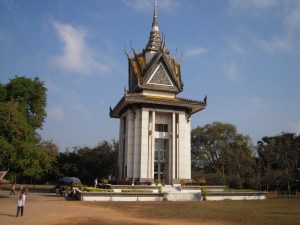
Memorial stands in Choeung Ek, Phnom Penh, but many Cambodians do not know the history of the Khmer Rouge and its brutal regime (here pictured in early 2010).
Planning for the tribunal began in 1998.
Snail-paced justice
The tribunal has experienced many setbacks. Judges have resigned, the Cambodian government has clashed with international officials and documents have been disputed. Such setbacks have left many wondering if justice will ever prevail.
Thet Sambath is one of those people. He has taken the pursuit of truth into his own hands. He is a senior reporter at the Phnom Penh Post and, in the last decade, has interviewed 1000 former Khmer soldiers, according to the Guardian.
He conducted these interviews in his spare time. The end goal is to expose what really happened during the Khmer Rouge years.
In an interview with the Guardian, Sambath claimed he wanted to know “why” these atrocities happened. He revealed the “how” in his prior documentary, Enemies of the People.
Truth is expensive, even in Cambodia
Sambath’s pursuit of truth has a hefty price tag. He has spent $10,000 USD, has no savings and lives in fear that the government is trying to make him disappear.
“I know too much about what really happened. They want me dead,” he told the Guardian. “Fear is always in my heart. I am worried where I am going, who is behind me, watching me, following me.”
Sambath’s fears are justified. The international community expressed anxiety over government corruption from the planning stages of the Khmer Rouge Tribunal. The UN insisted the tribunal include a mixture of Cambodian and international judges to safeguard against corruption. This mixture has been the source of many clashes and stagnation in the tribunal.
Risking it all
With no end in sight for the KRT, Sambath continues his quest for truth. But the question then becomes how far should a journalist go to get the story?
Foreign correspondents have died while covering war-torn regions. Without them, many stories would remain untold. But Sambath is not a foreign correspondent. He is a journalist reporting fearfully from his own country.
In the Guardian article, he shares stories about car chases and his constant need to move and hide from the government. Threats allegedly started after the release of his first documentary.
Sambath said he will not abandon his project, but he does plan to escape Cambodia prior to the documentary’s release.
His story begs a major question of journalistic practices and standards. How far should a journalist go to tell a story to minimize harm if it means increasing harm to him or herself?
If you want to know more about the Khmer Rouge, please also take a look at my other blog entries on thethunderbird.ca: Khmer Rouge trial proves justice too expensive for Cambodia or Khmer Rouge Tribunal sets new standard with first life sentence.
 Heather Caulder
I think the international Khmer Rouge tribunal is a farce at best. There is no way that trying five surviving members of the Khmer Rouge leadership will bring either justice or closure to the millions of innocent victims who have perished or are still reeling from their genocidal rule. I think the focus should be on education and raising awareness so that similar atrocities do not happen again.
Yes, I agree. The tribunal is inherently flawed and struggling to find purpose. I am interested in how Cambodians, in Cambodia and abroad, feel about the trials. There seems to be an overwhelming number of people who just want to forget that period in history, but the tribunal serves as a glaring reminder. That said, while a survey conducted in Phnom Penh found that a large number of Cambodians would support a tribunal, it also discovered that many do not know one is going on. So you are right, education is key. If you know anyone else who might want to discuss this topic, I appreciate any input. Thanks for the comment.