International soccer rules force more than pros to sidelines

I recently worked on a project with two journalism colleagues (Sadiya Ansari and Suzanne Ahearne). Our multimedia story package covered the issue of hijab and soccer. Young girls across Canada are being forced from the soccer field because the Fédération Internationale de Football Association (FIFA) regulations state that the hijab poses a safety risk. So far, no injuries have been reported and no medical tests can prove the hijab might injure players during games. Young men and boys who wear turbans are facing a similar dilemma: remove their turbans or sit on the sidelines. Local Canadian stories have and will continue to surface leading up to FIFA’s final vote in July on the approval of a new safety-tested hijab. This vote comes after FIFA lifted its hijab ban in March. FIFA’s hijab ban illustrates the extreme influence soccer’s international governing body has over local, amateur sport. See thethunderbird.ca for our original story. 

Canada.com published an article on May 20th that proves young men are being forced from the soccer field for wearing turbans. Aneel Samra, a 17-year-old in Montreal, was turned away during league registration for failing to agree to play without his turban.

No reports prove that the turban gives players an added advantage or threatens their wellbeing during play. But the league refunded Samra’s money regardless, according to Canada.com.

The LaSalle-based soccer league fears it could be fined for allowing players to wear turbans.

FIFA does not allow professional players to wear turbans during soccer games. And the Lac St. Louis Regional Soccer Association, the body that governs the LaSalle minor soccer association, has decided to enforce the no turban rule.

This decision comes at an interesting time as FIFA will vote on a safety-tested hijab in just over one month. It also raises an important question as to whether or not the hijab ban was ever really about safety.

If the safety-tested hijab is approved, will FIFA also have to consider allowing men to play with turbans?
Risking life to tell a story

I read an article in the Guardian about a Cambodian journalist a few weeks ago and wanted to share my reactions. I follow the Khmer Rouge Tribunal (KRT) and acquired an interest in Cambodian history after living in the country for a month in 2010.

Journalists take risks every day, but only a select few gamble their lives in the pursuit of truth. Cambodia’s Thet Sambath has wagered everything – home, family, life – in order to expose the facts behind his country’s violent past.

Between 1975 and 1979, the Khmer Rouge attempted to shape Cambodia into a utopian, agrarian society. Millions perished due to forced labour, starvation and torture.

The United Nations (UN) helped establish a tribunal intended to bring justice to the struggling country. So far, only one regime leader has been sentenced.

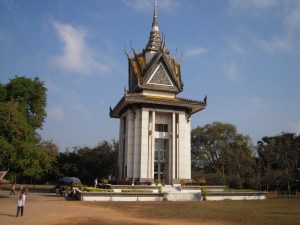
Memorial stands in Choeung Ek, Phnom Penh, but many Cambodians do not know the history of the Khmer Rouge and its brutal regime (here pictured in early 2010).

Planning for the tribunal began in 1998.

Snail-paced justice

The tribunal has experienced many setbacks. Judges have resigned, the Cambodian government has clashed with international officials and documents have been disputed. Such setbacks have left many wondering if justice will ever prevail.

Thet Sambath is one of those people. He has taken the pursuit of truth into his own hands. He is a senior reporter at the Phnom Penh Post and, in the last decade, has interviewed 1000 former Khmer soldiers, according to the Guardian.

He conducted these interviews in his spare time. The end goal is to expose what really happened during the Khmer Rouge years.

In an interview with the Guardian, Sambath claimed he wanted to know “why” these atrocities happened. He revealed the “how” in his prior documentary, Enemies of the People.

Truth is expensive, even in Cambodia

Sambath’s pursuit of truth has a hefty price tag. He has spent $10,000 USD, has no savings and lives in fear that the government is trying to make him disappear.

“I know too much about what really happened. They want me dead,” he told the Guardian. “Fear is always in my heart. I am worried where I am going, who is behind me, watching me, following me.”

Sambath’s fears are justified. The international community expressed anxiety over government corruption from the planning stages of the Khmer Rouge Tribunal. The UN insisted the tribunal include a mixture of Cambodian and international judges to safeguard against corruption. This mixture has been the source of many clashes and stagnation in the tribunal.

Risking it all

With no end in sight for the KRT, Sambath continues his quest for truth. But the question then becomes how far should a journalist go to get the story?

Foreign correspondents have died while covering war-torn regions. Without them, many stories would remain untold. But Sambath is not a foreign correspondent. He is a journalist reporting fearfully from his own country.

In the Guardian article, he shares stories about car chases and his constant need to move and hide from the government. Threats allegedly started after the release of his first documentary.

Sambath said he will not abandon his project, but he does plan to escape Cambodia prior to the documentary’s release.

His story begs a major question of journalistic practices and standards. How far should a journalist go to tell a story to minimize harm if it means increasing harm to him or herself?

If you want to know more about the Khmer Rouge, please also take a look at my other blog entries on thethunderbird.ca: Khmer Rouge trial proves justice too expensive for Cambodia or Khmer Rouge Tribunal sets new standard with first life sentence.